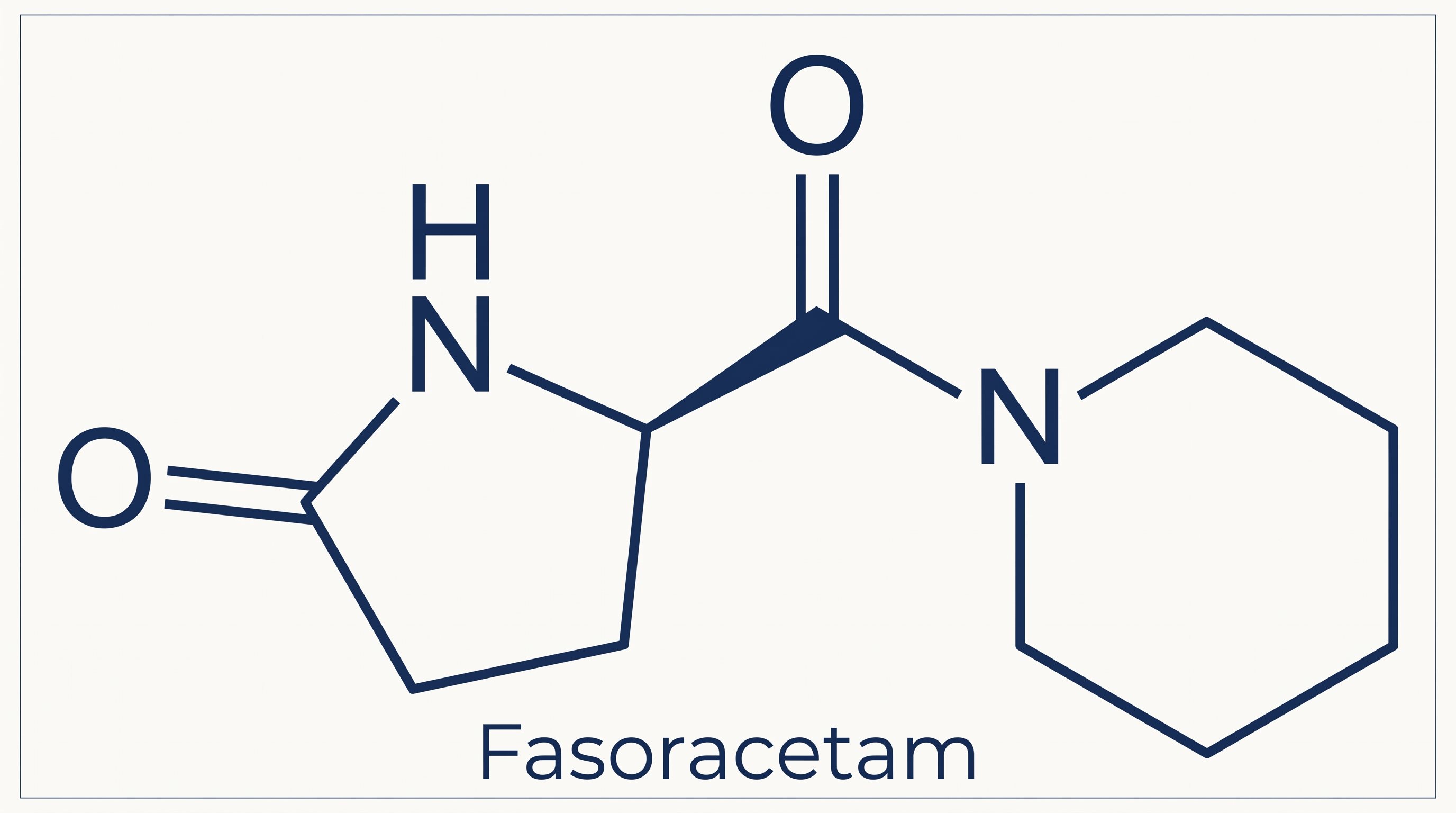
Originally article published on Nootriment in 2015. Updated and revised.
Fasoracetam for ADHD, Anxiety, and Memory: What the Trials Show
A failed dementia drug became a nootropic, then an ADHD candidate, then a rare-disease asset.
Fasoracetam has passed through five companies and carried at least five code names. Nippon Shinyaku discovered it in the late 1980s as NS-105, a candidate for the cognitive decline following strokes and small-vessel disease. The company took it to Phase 3 in dementia patients with cerebrovascular disease and abandoned it when it missed its efficacy endpoints. Safety was not the problem (Connolly et al., 2015). For a decade it sat in the company’s files. The nootropics community found it in the published literature.
Fasoracetam and memory: what the rat studies show
Most racetams, the family launched by piracetam in the 1960s, are famous for effects that are still being explained (Malykh & Sadaie, 2010). Fasoracetam acts on three systems at once, and the animal literature is specific about each.
The first is cholinergic. Fasoracetam enhances high-affinity choline uptake in the cortex and hippocampus and increases acetylcholine release from the cortex, the same property that made its cousin coluracetam appealing. In rats it reversed memory disruption across six different models: scopolamine, lesions of the basal forebrain, the cholinergic toxin AF64A, cerebral ischemia, electroconvulsive shock, and the muscle relaxant baclofen. Four reference drugs, aniracetam among them, were run alongside it in two of the tests. None of them touched baclofen (Ogasawara et al., 1999). In people, the Phase 3 dementia trial was the test of that promise, and it failed.
Baclofen is a GABA-B agonist, so that last result points to the second system. A single dose blunts GABA-B responses. Repeated dosing increases the number of GABA-B receptors in the rat cortex. That upregulation is the proposed mechanism for the antidepressant-like effects observed in rat studies. In the forced swim test, treated rats spent less time immobile, much as they do on desipramine. In learned helplessness, the model in which rats exposed to inescapable shock stop trying to escape, treated rats kept trying. Beta-adrenoceptor and 5-HT2 binding did not change, and the drug did not block monoamine uptake, so it does not work the way the classic antidepressants do (Shimidzu et al., 1997).
The third is glutamate. Fasoracetam modulates all three groups of metabotropic glutamate receptors (Oka et al., 1997; Connolly et al., 2015), a property that would later become relevant.
Hold this triangle in mind, because it’s the basis for the rest of our story.
Fasoracetam for ADHD: A Second Life
The glutamate piece revived it.
Hakon Hakonarson’s group at Children’s Hospital of Philadelphia had found that a subset of children with ADHD, perhaps one in ten, carry variants in a network of genes around the metabotropic glutamate receptors (Elia et al., 2012; Connolly et al., 2015). Thus, a drug that modulates mGluRs might help these children. Hakonarson’s company, neuroFix, licensed the drug from Children’s Hospital (Medgenics, 2016a). Medgenics bought neuroFix in 2015 and renamed itself Aevi Genomic Medicine at the end of 2016 (Medgenics, 2016b). The drug became NFC-1 and then AEVI-001.
An open-label study in adolescents with the variants, published in Nature Communications in 2018, reported improvements and no serious adverse events, which is what open-label studies in motivated families tend to report (Elia et al., 2018).
The controlled trials did not cooperate. SAGA, in 2017, randomized about a hundred adolescents with the variants to drug or placebo for six weeks, at doses up to 400 mg twice a day. It missed its primary endpoint, the change in score on the standard ADHD rating scale. The company pointed to its responder analyses, which count how many patients cleared a set bar. Seventy percent of treated patients against 42 percent on placebo improved by at least 30 percent, and clinicians rated 57 percent against 33 percent as much or very much improved (Aevi Genomic Medicine, 2017). The company saw a clear signal at the top dose.
ASCEND tried again in children and adolescents, 69 with the variants and 109 without. In January 2019 the company reported that it had missed in both groups (Aevi Genomic Medicine, 2019). Aevi terminated the program and returned the intellectual property to Children’s Hospital of Philadelphia (Cerecor, 2020).
Fasoracetam in 22q11.2 deletion syndrome: A Third Life
Nobias Therapeutics picked the drug up next, renamed it NB-001, and tried it in children with 22q11.2 deletion syndrome. The syndrome carries a heavy psychiatric burden, and no drug is yet approved to treat it.
The Phase 2 trial ran at four centers in the United States and Canada (NCT05290493). It randomized 37 children and adolescents to a placebo-controlled crossover: two six-week periods, one on drug and one on placebo, with a week’s washout between them. Thirty-four were dosed and 32 finished. The registered primary outcome was safety and tolerability, and there were no serious adverse events.
On the main efficacy measure, a clinician’s global rating of improvement, the drug beat placebo by about a third of a point (−0.36, p = 0.067). Sixty-one percent of drug periods were rated improved against 39 percent of placebo periods (p = 0.071). ADHD symptoms improved significantly. Anxiety and autistic traits trended in the same direction (Vogel et al., 2025). The sponsor’s summary, “statistically significant improvements in clinically relevant patient subgroups,” is the sentence a company writes when the main efficacy result came close and did not get there. In this case it is also an accurate one. A trial with 32 completers cannot settle the question.
The FDA granted the drug Orphan Drug and Rare Pediatric Disease designations in 2024 (Nobias Therapeutics, 2024). In July 2026 an Icelandic company, Synaptiq Therapeutics, acquired Nobias’s assets, renamed the drug SYN-001, and announced a Phase 2b trial for the same indication, to be run on a clinical global impression scale written for this syndrome (Synaptiq Therapeutics, 2026). A fifth company will now pay for a drug that has failed in three larger populations. Orphan designation offers a commercial reason to try again: the possibility of seven years of market exclusivity if the drug wins approval (FDA, n.d.).
Fasoracetam for Anxiety
The case for anxiety rests on the GABA-B data in rats. Many users take the drug for that reason, some of them after phenibut. The human evidence is one secondary result: in the 22q11.2 trial, anxiety scores in children trended toward improvement and did not reach significance (p = 0.07). None of the trials discussed here tested the drug for anxiety in adults. Redditors report less anxiety.
That effect remains unproven, despite the anecdotal evidence.
The Extant Evidence
So the ledger, after nearly forty years: one Phase 3 failure in dementia, two controlled misses in ADHD, one small crossover trial in a rare syndrome with its main efficacy result at p = 0.067 and a significant secondary result on ADHD symptoms, and a fifth company now paying for the answer.
The published trials discussed here did not test fasoracetam as a cognitive enhancer (nootropic) in healthy adults. The healthy-volunteer studies measured how the drug moves through the body, not what it does to a mental performance. The absence of a trial is not proof that the drug does nothing. It means this particular use has not yet been rigorously evaluated.
Dosage, Safety, and Legal Status
Fasoracetam is not approved for any use anywhere. It is sold online as a research chemical by providers like SwissChem. The law defines a dietary ingredient as a vitamin, a mineral, an herb, an amino acid, or a dietary substance that supplements the diet (21 U.S.C. § 321(ff)). It is hard to see where a synthetic drug candidate fits. The FDA has treated piracetam products sold online as unapproved drugs (FDA, 2019). It has not ruled on fasoracetam.
Calling it a supplement does not make it one. Australia lists it in Schedule 4, the prescription-only category. The listing sets how it could be sold. It does not mean anyone sells it (Australian Government, 2026).
There is no established human dose. The clinical programs used fixed oral doses of 100 to 400 mg twice a day in supervised settings. The sublingual microdoses described on forums are folklore.
The pharmacokinetics are known: after a single 100 mg dose, the half-life was about four and a half hours in young adults and about five in the elderly (Connolly et al., 2015). Short-term tolerability in trials has been reasonable. These short-term trials do not establish the safety of years of use, which is the way enthusiasts use it.
Fasoracetam has an unusually well-described mechanism for a racetam. It was promising enough to attract four more companies after the first gave up, but it has not yet delivered a clear clinical win. For now, it remains a passing curiosity among nootropics enthusiasts.
References
Aevi Genomic Medicine. (2017, March 20). Topline results of the SAGA trial of AEVI-001 (NCT02777931); as reported by BioSpace.
Aevi Genomic Medicine. (2019, January 2). Topline results of the ASCEND trial (Parts A and B, NCT03265119 / NCT03609619); as reported by Zacks.
Australian Government. (2026). Therapeutic Goods (Poisons Standard—October 2026) Instrument 2026 (F2026L01327). Federal Register of Legislation.
Cerecor Inc. (2020, February). Form 8-K, Exhibit 99.4: Aevi Genomic Medicine management’s discussion and analysis. U.S. Securities and Exchange Commission.
Connolly, J. J., Glessner, J. T., Elia, J., & Hakonarson, H. (2015). ADHD and pharmacotherapy: Past, present and future. Therapeutic Innovation & Regulatory Science, 49(5), 632–642.
Elia, J., et al. (2012). Genome-wide copy number variation study associates metabotropic glutamate receptor gene networks with attention deficit hyperactivity disorder. Nature Genetics, 44(1), 78–84.
Elia, J., et al. (2018). Fasoracetam in adolescents with ADHD and glutamatergic gene network variants disrupting mGluR neurotransmitter signaling. Nature Communications, 9, 4.
Federal Food, Drug, and Cosmetic Act, 21 U.S.C. § 321(ff).
Malykh, A. G., & Sadaie, M. R. (2010). Piracetam and piracetam-like drugs: From basic science to novel clinical applications to CNS disorders. Drugs, 70(3), 287–312.
Medgenics, Inc. (2016a). Form 10-K for the fiscal year ended December 31, 2015. U.S. Securities and Exchange Commission.
Medgenics, Inc. (2016b, December 15). Medgenics, Inc. announces name change to Aevi Genomic Medicine, Inc. Press release.
Nobias Therapeutics. NB-001 in children and adolescents with 22q11 deletion syndrome (NCT05290493). ClinicalTrials.gov.
Nobias Therapeutics. (2024, December). Press release announcing FDA Orphan Drug and Rare Pediatric Disease designations for fasoracetam in 22q11.2 deletion syndrome.
Ogasawara, T., et al. (1999). Involvement of cholinergic and GABAergic systems in the reversal of memory disruption by NS-105, a cognition enhancer. Pharmacology Biochemistry and Behavior, 64(1), 41–52.
Oka, M., et al. (1997). A novel cognition enhancer NS-105 modulates adenylate cyclase activity through metabotropic glutamate receptors in primary neuronal culture. Naunyn-Schmiedeberg’s Archives of Pharmacology, 356(2), 189–196.
Shimidzu, T., et al. (1997). Effect of a novel cognition enhancer NS-105 on learned helplessness in rats: Possible involvement of GABA-B receptor up-regulation after repeated treatment. European Journal of Pharmacology, 338(3), 225–232.
Synaptiq Therapeutics / Nobias Therapeutics. (2026, July 23). Synaptiq Therapeutics launches with acquisition of clinical-stage SYN-001 program. Press release.
U.S. Food and Drug Administration. (2019, February 5). Warning letter to Pure Nootropics, LLC (MARCS-CMS 565425).
U.S. Food and Drug Administration. (n.d.). Designating an orphan product: Drugs and biological products.
Vogel, M., et al. (2025). Fasoracetam for neuropsychiatric symptoms in children and adolescents with 22q11.2 deletion syndrome: A randomized crossover Phase II clinical trial. Biological Psychiatry, 97(9S), poster abstract 343.
This article is for information only and is not medical advice. Fasoracetam is an unapproved investigational drug, and nothing here is a recommendation to buy or use it. Talk to a physician before taking any drug or supplement.


Leave a Reply