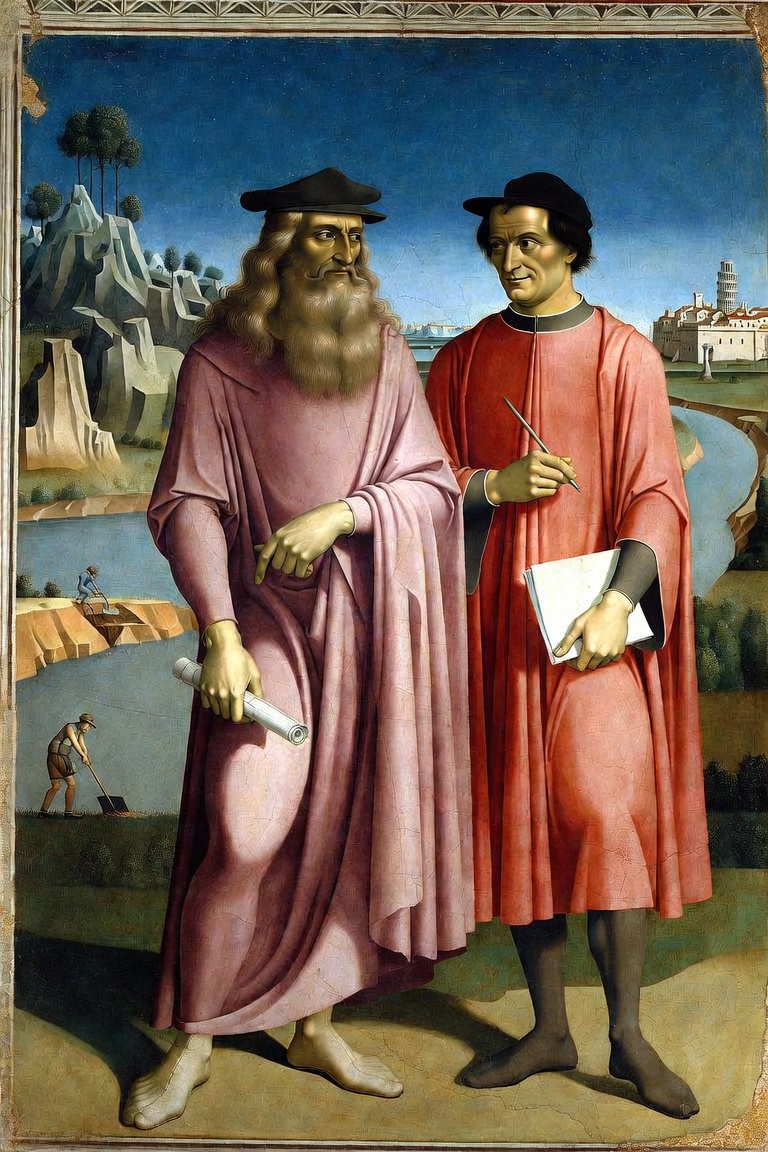
In 1503 Leonardo da Vinci surveyed the Arno for Florence, and Niccolò Machiavelli drove the plan forward. Florence began digging in 1504, but the river and a contractor had other ideas.
One of the most famous passages in The Prince may have been more than a metaphor:
“I compare her [Fortuna] to one of those raging rivers, which when in flood overflows the plains, sweeping away trees and buildings, bearing away the soil from place to place; everything flies before it, all yield to its violence, without being able in any way to withstand it; and yet, though its nature be such, it does not follow therefore that men, when the weather becomes fair, shall not make provision, both with defences and barriers, in such a manner that, rising again, the waters may pass away by canal, and their force be neither so unrestrained nor so dangerous.”
— Niccolò Machiavelli, The Prince, chapter XXV (trans. W. K. Marriott)
Pisa threw off Florentine rule in 1494, and Florence would not retake it for fifteen years. The city sat downstream on the Arno, seven miles from the coast, and the river was its path to the Ligurian Sea. Florence had no port of its own, so it needed Pisa’s. Repeated sieges failed. Mercenaries took the Republic’s golden florins and declined to die for the cause.
The scheme took shape in Florentine councils before anyone famous entered the picture, and it was tantalizingly simple: if you cannot conquer a city, remove what’s keeping it alive. In 1496 a speaker in the council suggested that diverting the Arno would be straightforward. Four years later another called it imperative. Maybe it would be easy. After all, the river had done it once on its own accord in 1333. Following four days of rain the Arno broke out of its bed below Pisa and cut a new channel to the sea through a lagoon near Livorno.
What a rerouted river would buy was spelled out in the chancery’s letters. Pisa would lose its grain, trade, and reinforcements. The fields the Pisans sowed along the river would drown, and the ditches themselves would stop their cavalry raids. If the new channel could be made navigable to the Stagno, Florence’s goods, “le mercatanzie nostre” as Machiavelli called them, could reach the Mediterranean without passing under Pisan walls.
What was new in 1503 was the name. Soderini’s government needed to win over a council, the pratica, that doubted the Pisans would suffer much and thought the five-thousand-florin estimate was a fantasy. Leonardo, fresh from Cesare Borgia’s service, was the answer to the doubters. A drawing of the plan was shown to the council in February 1504. The minutes don’t say who made it. If it was Leonardo’s, it may be the only time anyone called his work “badly drawn.” The historian Guicciardini later called the venture a ghiribizzo, a fanciful whim, with the easy clarity of hindsight. The Signoria went forward with it anyway.
Machiavelli, Piero Soderini’s right hand, ran the chancery’s military correspondence. As Florence’s envoy to Borgia, he had seen Leonardo’s work.
On 21 June 1503, two days after Florentine troops took the hill fortress of La Verruca above Pisa, the officer in command wrote home: “Leonardo da Vinci came in person, with some companions, and we showed him everything.” A month later Leonardo was back with an official delegation led by Alessandro degli Albizzi, who carried a letter from Soderini. The Signoria reimbursed Leonardo’s travelling companion, Giovanni the piper, fifty-six lire for a carriage with six horses and meals, “going with Leonardo da Vinci to level the Arno around Pisa.”
Renaissance Italy was a small world. Giovanni was likely the father of renowned goldsmith and sculptor Benvenuto Cellini, whose brawls, boasts, and eccentricities fill his celebrated Autobiography. That October a clerk in Machiavelli’s office, Agostino Vespucci, scribbled in the margin of his Cicero that Leonardo was at that moment painting a portrait of Lisa del Giocondo. News of the Mona Lisa and the Arno plan passed through the same office in the same season. One immortal, the other doomed to wash away.
Leonardo’s notes are what you would expect from him: exact about the work and frustratingly quiet about who would pay, who would command, and how two thousand men could be kept shoveling under fire. The river would be turned south into the Stagno by a principal cut about a mile long and sixteen braccia deep, roughly thirty feet, forking into smaller channels; the full route to the outflow ran about twelve miles. He calculated that a million tons of earth would have to come out, that a bucket from the bottom would pass through fourteen pairs of hands on its way to the top, and that the whole thing would take fifty-four thousand man-days. He specified shovel-loads, barrow-loads, cart-loads. He drew the maps. The principle under all of it was the obvious one: the new bed must be lower than the old, or else the river would refuse to turn.
Then the Florentine Republic, as governments do and have always done, hired a contractor.
Work began on 20 August 1504, under a hydraulic engineer named Colombino, and what was dug was not according to Leonardo’s specifications. Instead of one deep cut he made two shallow ones, apparently believing that the water would excavate the rest: let it flow in, he reasoned, and it would scour its own bed and tear out the spur of earth between the two channels. Two thousand labourers were hired at a carlino a day, and a thousand soldiers stood guard because the Pisans were not going to watch their lifeline leave without a fight. Machiavelli’s assistant Biagio Buonaccorsi recorded that while the engineers had promised thirty or forty thousand man-days, eighty thousand was “not enough to bring it even halfway.”
By now Leonardo was elsewhere, but Machiavelli was everywhere. Between the middle of August and the middle of October he wrote ninety-five letters about the works. He ordered digging on feast days, asked the local vicars to punish deserters, and told the camp it was not to move. On 28 September he reported to the commissioners that the council urged the work forward, and conveniently left out the part where it had advised withdrawing if the weather turned. Once more, Fortune did not smile upon Florence.
When the Arno flooded it entered the ditches. When it fell, the water retreated. The hoped-for scouring never happened, and the Arno returned to its old route through Pisa. In early October a storm sank several boats guarding the mouths of the channels, killing eighty men. The ditch walls fell in and the plain flooded. Florence sent for the architect Biagio Rossetti to see what could be salvaged, and his answer was nothing. By the middle of the month the undertaking was abandoned. It had cost the Republic seven thousand ducats. The Pisans unceremoniously filled the holes. Yet the story has a happy ending for the Republic. Pisa fell the old-fashioned way in 1509, to starvation and a citizen militia organized by Machiavelli.
Meanwhile, Leonardo had another Florentine commission on his desk: a battle scene for the wall of the Great Council Hall. He began painting it the following year. The paint would not hold, for reasons still debated, and he walked away from it. No part of this famously unfinished piece remains.
Nine years later, out of office and under suspicion, Machiavelli was writing The Prince at his farm. Fortune was a river (or a river was fickle Fortuna). Nobody can prove he was thinking of Pisa, but of all the metaphors available to a scholar of his caliber, he chose the one he had watched his city fail to overcome. Virtù, the foresight and nerve he praises, is a dike built in fair weather. Note the direction. In the book the dikes go up before the flood. At Pisa, Florence had tried something more aggressive: to turn the Arno itself into a weapon, in August, under fire, with a corner-cutting contractor.
The Renaissance’s greatest draftsman drew the plan and her sharpest political mind ran the paperwork, ninety-five letters of it, and yet the job was lost between a contractor’s shortcuts, a Republic’s purse, the wages of a thousand soldiers, the one word Machiavelli left out of a letter, and the weather. A Florentine historian of architecture, Emanuela Ferretti, warns against imagining the two of them as “a pair of conspirators or close collaborators,” and the record agrees with her; one drew, one wrote letters, and they may barely have been in the same room. Two of history’s most influential minds spent the summer of 1503 learning what so many others have learned after hiring a contractor: the drawing is not the ditch, though it may fall into one.
To this day the Arno ambles through Pisa.
References
Machiavelli, Niccolò. The Prince. Translated by W. K. Marriott, 1908.
Nicholl, Charles. Leonardo da Vinci: The Flights of the Mind. London: Allen Lane, 2004.
D’Errico, Dora. “« Se è da fare opera da volgere Arno »: Léonard au service du projet de détournement de l’Arno (1503–1504).” Cromohs 19 (2014): 80–97.
Tep, Ratha. “Inside da Vinci and Machiavelli’s Plot to Weaponize a River.” History, August 31, 2026. https://www.history.com/articles/da-vinci-machiavelli-plot-arno-river-pisa
Humphries, Paul. “Leonardo da Vinci: Rivers, Water, Science and Art (Part 3: Diverting the Arno).” River Ecology and Research, September 5, 2014. https://paulhumphriesriverecology.wordpress.com/2014/09/05/leonardo-da-vinci-rivers-water-science-and-art-part-3-diverting-the-arno/
Heidelberg University. Press release on Agostino Vespucci’s 1503 marginal note identifying the sitter of the Mona Lisa. https://www.uni-heidelberg.de/press/news/press552e.html
Further reading
Masters, Roger D. Fortune Is a River: Leonardo da Vinci and Niccolò Machiavelli’s Magnificent Dream to Change the Course of Florentine History. New York: Free Press, 1998.
Kemp, Martin. Leonardo da Vinci: The Marvellous Works of Nature and Man. Rev. ed. Oxford: Oxford University Press, 2006.
Geddes, Leslie A. Watermarks: Leonardo da Vinci and the Mastery of Nature. Princeton: Princeton University Press, 2020.
Ferretti, Emanuela. “Fra Leonardo, Machiavelli e Soderini: Ercole I d’Este e Biagio Rossetti nell’impresa ‘del volgere l’Arno’ da Pisa.” 2019.


Leave a Reply