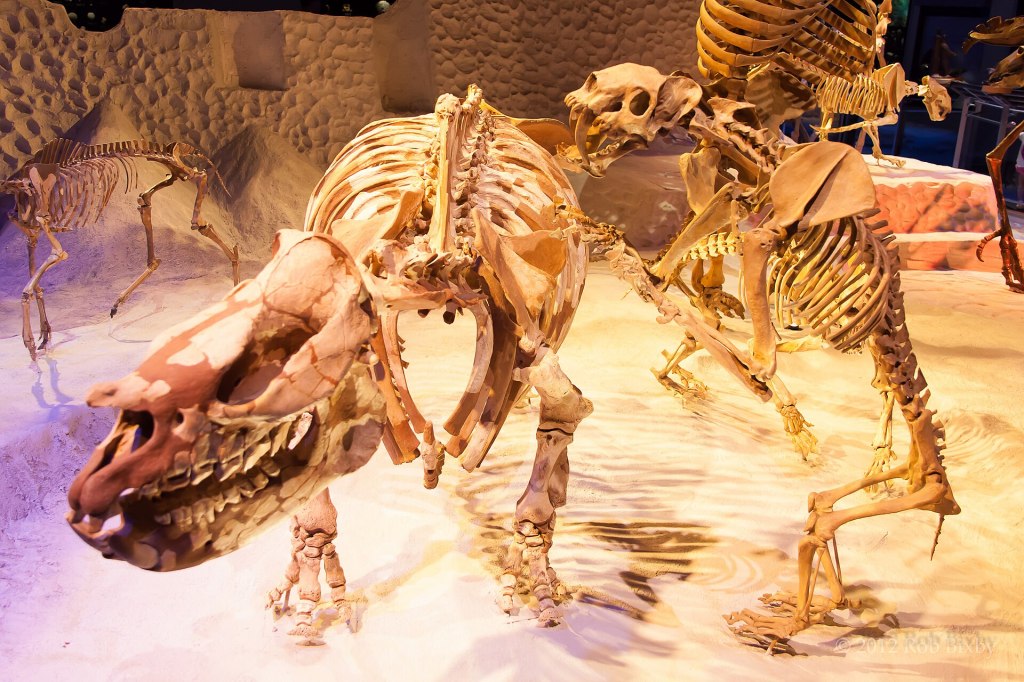
B. loveorum attacking a Teleoceras at the Florida Museum of Natural History
A Joke in an Okra Field
The air hangs heavy over a Miocene creek. Dragonflies weave and bob over the water as Barbourofelis crouches in the shade of a saw palmetto.
Across the shallows, a rhino calf nudges reeds beside the stream. Her mother is a few steps behind, but she might as well be on the other side of the savanna. The hunter’s forelimbs tense; he must make a quick kill.
Shoving the soil with a familiarly feline grace, he pounces. The impact, shoulder to ribs, topples the calf. His claws keep it corkscrewed to the ground while he finds the exact angle his supersized canines require. The calf’s scream does not end, at least not of its own accord.
Florida’s creeks remember these scenes. Places like Archer’s Love Bone Bed kept the receipts. This unsuspecting okra field has yielded over twenty thousand identifiable specimens so far.
Appearances aside, Barbourofelis wasn’t a cat. It was something older and stranger and, if you want to impose a narrative upon its remains, the punchline to a 40-million-year-old joke.
Not a Cat
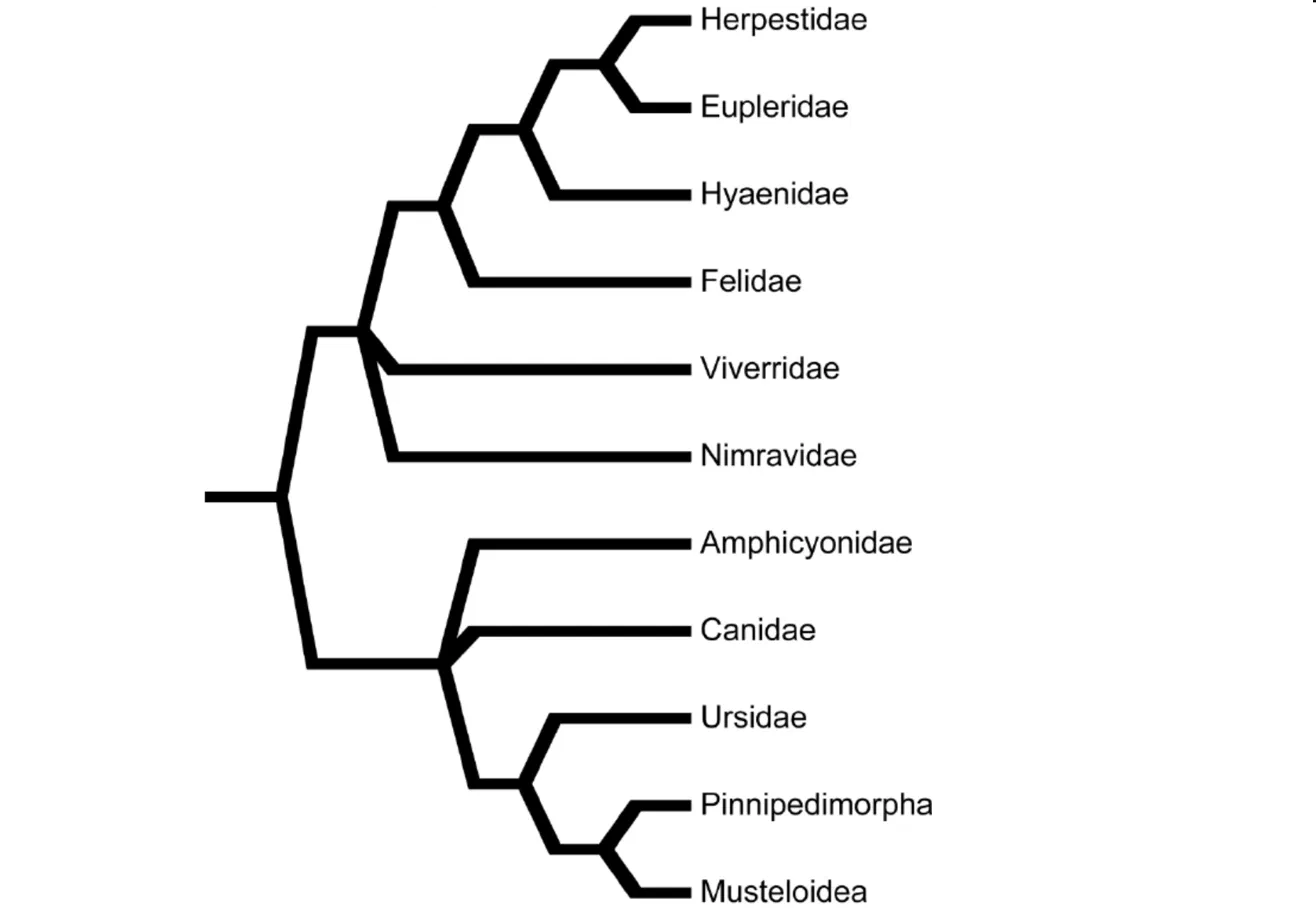
Some references place Barbourofelis in a separate family, Barbourofelidae. The cladogram above does not.
Recent studies of the basicranium, the bony architecture surrounding the middle ear, have been pulling them back into Nimravidae as a subfamily. Since this structure changes slowly, it is considered a more reliable indicator of ancestry. Barbourofelis’s teeth tell a different story, sharing features with true felids that have led some researchers to separate them from nimravids entirely. The debate is unsettled, but species from both groups can be called “false cats” in good conscience.
Nimravids and true cats are cousins, not siblings. Both are feliforms, on the cat side of Carnivora (as opposed to the dog side). Their lineages split somewhere in the Eocene, long before Proailurus, the first true cat, appeared 30 million years ago. Sabertoothed nimravids had already made big game hunting a lifestyle.
But that was not the first time evolution tried the sabertooth body plan. The machaeroidines, a small clade of Eocene creodonts, got there 50 million years ago. Creodonts were an extinct branch of mammalian predators, separate from Carnivora. If you widen the lens, there were the gorgonopsians, therapsids whose saber-like canines terrorized the planet 260 million years ago—predating the oldest undisputed dinosaur fossil by 27 million years.
Gorgonopsians had a good run, but they were wiped out by the worst mass extinction in Earth’s history. Sabertoothed varieties stalked the Pangean supercontinent for roughly eighteen million years, and the most extreme blade-canined forms, like Inostrancevia and Rubidgea, dominated the final stretch of the Permian before the Great Dying.
Nimravids were the first carnivorans to commit to the design, and the first lineage to build an enduring strategy around it, spreading across three continents over thirty-three million years.
Of course, evolution rarely produces one-hit wonders. Long canines, a flanged jaw, and grappling forelimbs worked so well that this body plan arose repeatedly. Various false cats did it before Smilodon, Homotherium, and their ilk. It wasn’t even confined to placental mammals; a South American sparassodont (related to marsupials), Thylacosmilus, stumbled on this blueprint in the late Miocene.
Sometimes the knock-off replaces the original. Advantages compound over time. Disadvantages do too.
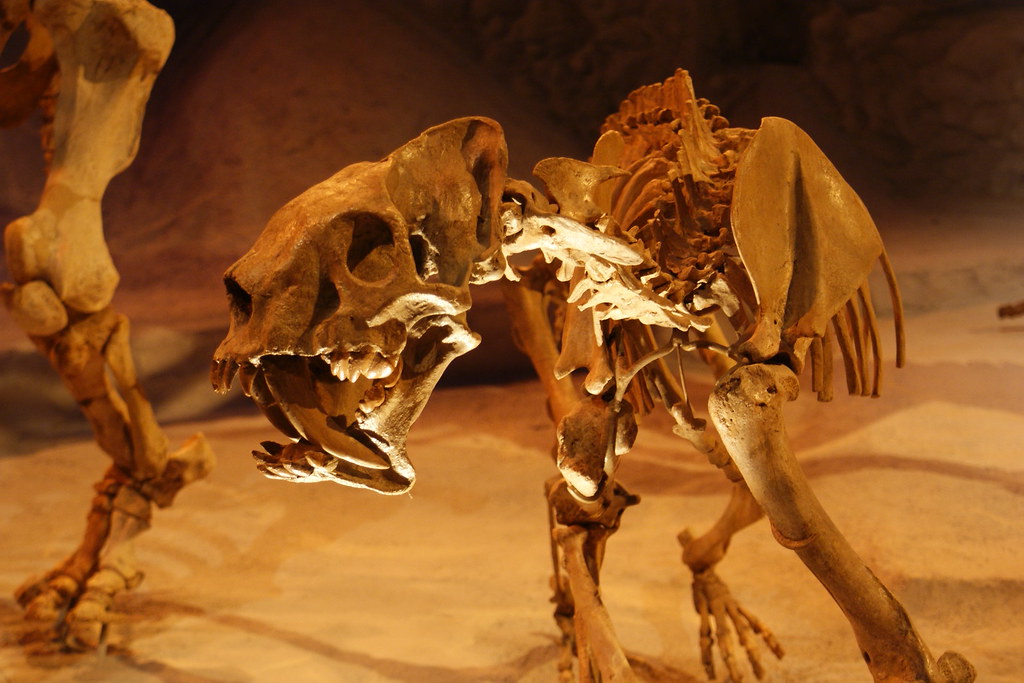
Florida’s Star: Barbourofelis loveorum
Barbourofelis loveorum weighed around 150 pounds, although some estimates run higher. This jaguar-sized false cat sported heavily muscled forelimbs and a complete bony “eyeglass frame” behind each eye. Its mandibular flange, a bony holster growing down from the lower jaw, kept its precious killing tools from snapping off during a long nap.
Bone cross-sections and limb measurements point to the same conclusion: this animal pounced from dense cover and could take down large prey.
But if you’re a saber-toothed predator, there’s a trade-off: you can’t “bite and hold” your lunch like a modern lion. Your canines are long and sharp but brittle. Hit the wrong angle they’ll shatter. Get it right—pin the prey, corkscrew it to the ground, and find that perfect angle—and you’ll be eating well.
High risk, high reward. You can have precision or power, but not both. Based on living felids, it looks like precision has won for now.
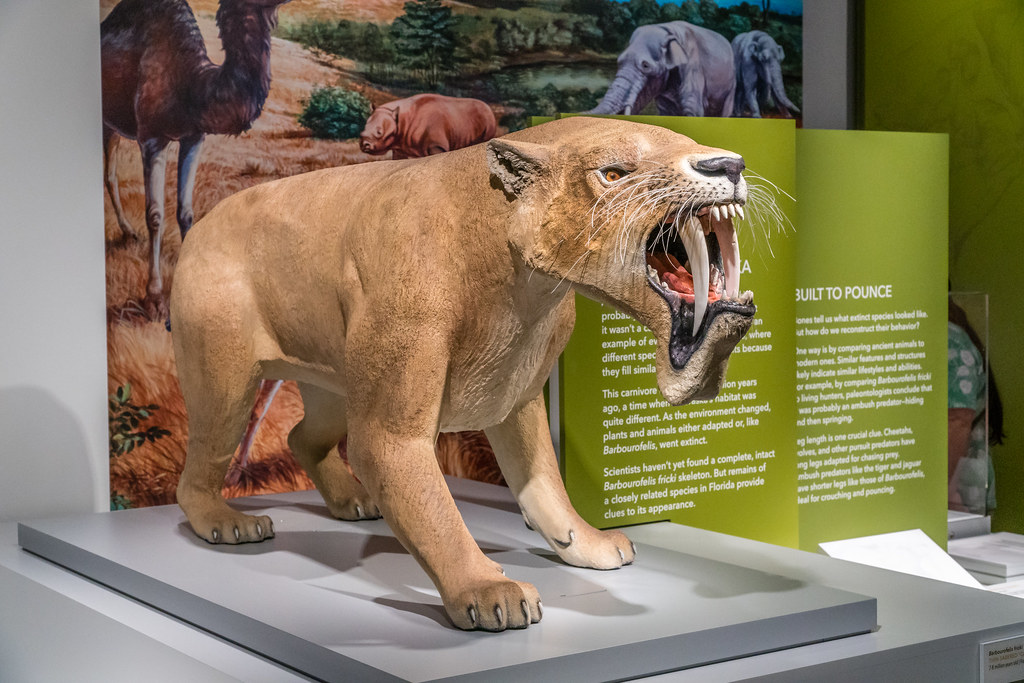
Barbourofelis fricki and the Body Plan
But B. loveorum wasn’t the biggest. That honor goes to B. fricki, the last and largest of the barbourofelids. Weight estimates vary. Antón (2013) puts it at around 200 kg (440 lb), with other reconstructions ranging as high as 300 kg (660 lb). Either way, you didn’t want to be on the receiving end of its hunger or displeasure.
Modern big cats have long, athletic strides. B. fricki stayed low to the ground.
Its humerus and femur were incredibly dense, with massive areas for muscle attachment. The ratio of limb length to bone thickness resembles a bear’s more than a true felid’s. True cats are digitigrade; they walk on their toes with their heels elevated.
Biomechanical analyses of Barbourofelis feet, especially B. fricki, suggest it had a subdigitigrade or semi-plantigrade stance. Walking flat-footed is a classic ursid (bear) trait. It trades top-end pursuit speed for a stable platform when grappling with large prey.
In a 2005 paper by Jon A. Baskin and later ecomorphological studies, researchers noted that Barbourofelis did not move through its environment like a typical cat. Instead of a stealthy, slinking walk, its skeletal geometry suggests a heavy, deliberate, “ambulatory” gait like a wolverine’s.
Its takedowns couldn’t be sloppy. A lion can chase a zebra, leap onto its back, and ride it down. Barbourofelis gave up cat-like agility for brute strength. Its stocky arms could pin large prey flat against the dirt before it brought out its fangs.
B. fricki roamed the plains of Kansas, Nebraska, Texas, and Nevada alongside bear-dogs, bone-crushing canids, and true cats. Its ancestors came from another hemisphere.
Globe Stalkers
Barbourofelines originated in Early Miocene Africa and migrated into Europe at least three times, then radiated across Eurasia before crossing the Bering land bridge into North America around 12 million years ago. One branch, B. piveteaui, may even have migrated back to Eurasia, all the way to what is now Turkey.
In 1974, Ron Love brought a fossil rhino leg from his okra field to the Florida Museum of Natural History. Excavations exposed a near-shore stream fill, a single bend in a vanished river that sampled estuary, swamp, thicket, and savanna. This treasure trove would eventually reveal:
- Teleoceras proterum.
- Aepycamelus major.
- Horses, tapirs, and peccaries.
- Eleven genera and twelve species of Carnivora.
A single creek bed, twenty minutes from Gainesville, has preserved more carnivorans than almost any other site of its age.
It’s still there, and most of it is unexcavated. The creek is there too, more or less. The cypress shifted, the monsters are gone, and the sediment that filled the channel now lies under farmland.
The Cost of Sabers
Barbourofelis cubs were late bloomers.
Analysis of juvenile skeletons shows that the milk sabers, “baby tooth” canines, erupted late. Cubs reached near-adult size before those deciduous teeth arrived. That means they were dependent on their mother, or possibly a family group, well into their second year, like modern lions.
Biomechanical models of juvenile skulls suggest the cubs couldn’t hunt at all. Without functional sabers, they likely scavenged from family kills, tearing muscle with their incisors. A long period of parental care has led to speculation that Barbourofelis may have been social animals. It might mean near-adult cubs helped restrain prey while mom or dad or a more distant relative finished the job.
The convergence runs deeper than the adult form. In nimravids, true cats, and barbourofelids, the permanent saber erupts inside a groove on the back of the milk saber, which stays in place until the adult tooth reaches full length. Two (maybe three) separate lineages didn’t just arrive at the same weapon, they arrived at the same way to grow it.
It also meant that raising a sabertooth was a front-loaded cost. As the world changed, it became harder to make the investment pay.
Open Wide
Early reconstructions suggested B. fricki could gape over 115 degrees. For reference, a housecat can do about 45, a lion about 65, and most humans can manage 30. Even Smilodon only hit about 90. A 115-degree gape is wider than a right angle, which sounds absurd. Later research found it was.
Biomechanical work with finite element analysis and muscle attachment modeling brought that figure down. Recent work by Figueirido and colleagues places B. fricki‘s maximum gape at roughly 73 to 89 degrees, depending on the muscle reconstruction used. Wider than a lion’s, but barbourofelids were not unhinging their jaws.
The 115-degree figure was probably never close to right. The revised models suggest the jaw muscles could not sustain it because they lose mechanical advantage somewhere between 73 and 89 degrees. And even if they could, those thin, blade-like canines would have been under dangerous lateral stress at extreme angles. Two separate constraints point to the same conclusion: their gape was wide, but not that wide.
A Real Cat with a Misleading Name
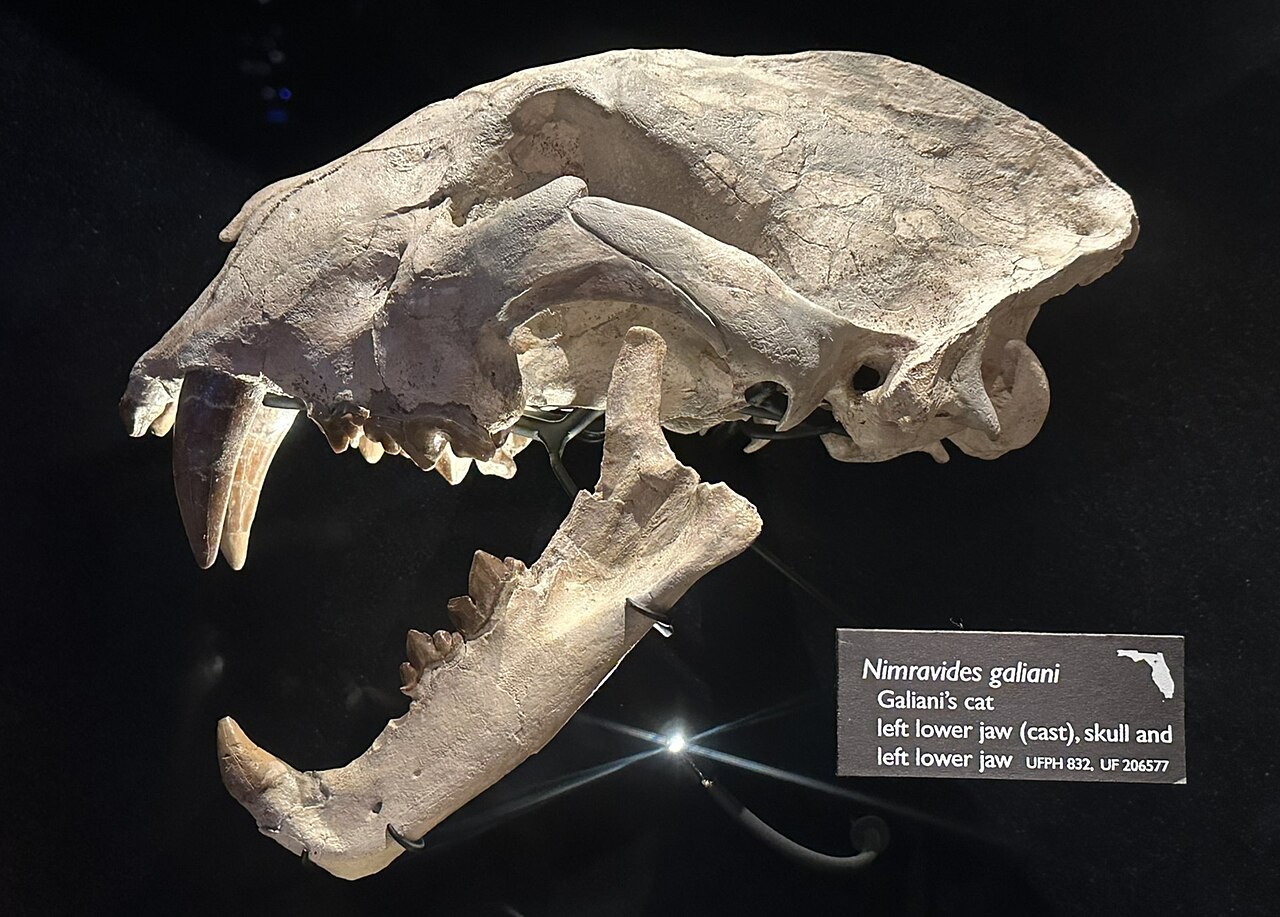
The Love Bone Bed also preserves Nimravides galiani.
At this point Barbourofelis had already perfected the saber-toothed look. Meanwhile, Nimravides—a true felid despite its name—was beginning to resemble Smilodon millions of years before Smilodon.
Nimravides means “nimravid-like,” but it is not a nimravid. It was a bona fide felid. These two were not rivals in a visceral sense; they were more likely partitioning the niche.
Whereas Barbourofelis was not built for open ground, Nimravides was a sprinter. It stayed out in the open patches of scrub and grassy savanna where it had ample opportunity to chase down prey.
What Killed the False Cats?
B. fricki, the last standing species, went extinct seven million years ago.
The old explanation was that true sabertooth cats showed up and drove out the false ones, but nimravids and machairodonts coexisted for millions of years. While they weren’t best friends, they weren’t fighting with each other or competing for the same food sources.
As it was with Gigantopithecus, habitat shift and prey turnover are the most likely culprits for the extinction of the nimravids. They faded first from Asia, then North America. Europe’s humid subtropical forests provided a final refuge, but when those too gave way to grassland the dense cover Barbourofelis depended on became patchier. The prey it was shaped to hunt—horses, camelids, and dromomerycids—began to disappear. Meanwhile, true cats, with their cursorial physiques, exploited these emerging conditions.
Nature does not crown winners, at least not for long. It keeps whatever fits and throws the rest out. When the world changed, the original sabertooths could not keep up.
The Joke That Never Gets Old
Evolution does not keep its originals, just what works for now. Places like the okra field are just where it left its receipts.
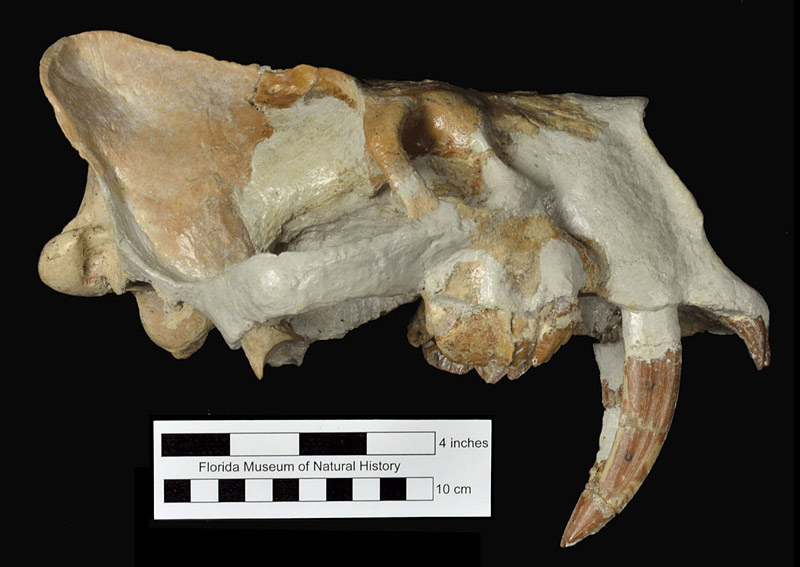
The holotype skull of B. loveorum, UF specimen 24447, lives at the Florida Museum of Natural History. For years that museum has featured an often-photographed Barbourofelis in its fossil hall. With the 2026 renovations wrapping up, you should soon be able to see it in person again.
If you’re in Gainesville, drop by and say hello to him.
Quick FAQ
Q: How big was it compared to Smilodon?
A: Comparable in some estimates, smaller in others. Smilodon fatalis weighed up to roughly 280 kg (620 lb). B. fricki estimates center around 200 kg (440 lb) but range as high as 300 kg (660 lb). Smaller on average, but Barbourofelis had longer canines relative to its skull, so its proportions were more extreme.
Q: Could it roar?
A: Unclear. Barbourofelids had a different ear-bone structure than true cats: ossified bullae with no septum, or no bulla at all. Since the auditory bullae are linked to the hyoid apparatus that supports the larynx, this difference may have affected the kinds of sounds they could make. No one has found a preserved larynx, so we can’t say for sure.
Q: What’s the “cat gap”?
A: A roughly 6.5-million-year stretch in North America, about 25 to 18.5 million years ago, when no cat-like predators were present on the continent. The classic Oligocene nimravids had gone extinct and true cats had not yet crossed the Bering land bridge from Eurasia.
Bear-dogs and bone-crushing canids ran the show. Barbourofelis shows up in North America much later, around 12 million years ago, as a re-entry from Eurasia, well after felids had already arrived. It lived alongside true sabertooth cats here, not before them.
References
Antón, M. 2013. Sabertooth. Bloomington: Indiana University Press.
Averianov, A., E. Obraztsova, I. Danilov, P. Skutschas, and J. Jin. 2016. “First nimravid skull from Asia.” Scientific Reports 6: 25812. https://doi.org/10.1038/srep25812
Baskin, J. A. 1981. “Barbourofelis (Nimravidae) and Nimravides (Felidae), with a description of two new species from the late Miocene of Florida.” Journal of Mammalogy 62(1): 122–139.
Baskin, J. A. 2005. “Carnivora from the late Miocene Love Bone Bed of Florida.” Bulletin of the Florida Museum of Natural History 45(4): 413–434. https://doi.org/10.58782/flmnh.oveu6772
Bryant, H. N. 1988. “Delayed eruption of the deciduous upper canine in the sabertoothed carnivore Barbourofelis lovei (Carnivora, Nimravidae).” Journal of Vertebrate Paleontology 8(3): 295–306.
Bryant, H. N. 1990. “Implications of the dental eruption sequence in Barbourofelis (Carnivora, Nimravidae) for the function of upper canines and the duration of parental care in sabretoothed carnivores.” Journal of Zoology 222(4): 585–590.
Bryant, H. N. 1991. “Phylogenetic relationships and systematics of the Nimravidae (Carnivora).” Journal of Mammalogy 72(1): 56–78.
Cope, E. D. 1880. “On the Nimravidae and Canidae of the Miocene period.” Bulletin of the U.S. Geological and Geographical Survey of the Territories 6: 165–181.
Figueirido, B., S. Tucker, and S. Lautenschlager. 2025. “Comparing cranial biomechanics between Barbourofelis fricki and Smilodon fatalis: Is there a universal killing-bite among saber-toothed predators?” The Anatomical Record 308(11): 2962–2975. Published online April 2024. https://doi.org/10.1002/ar.25451
Hulbert, R. C., Jr., ed. 2001. The Fossil Vertebrates of Florida. Gainesville: University Press of Florida.
Morlo, M., S. Peigné, and D. Nagel. 2004. “A new species of Prosansanosmilus: Implications for the systematic relationships of the family Barbourofelidae.” Zoological Journal of the Linnean Society 140(1): 43–61.
Ormsby, C., and J. X. Samuels. 2020. Inferred locomotion of select feliforms: Implications for Barbourofelis loveorum (Barbourofelidae) and Nimravides galiani (Felidae, Machairodontinae) from the late Miocene (latest Clarendonian) of Florida. Poster presentation. Journal of Vertebrate Paleontology, Program and Abstracts, 2020: 256.
Peigné, S., and L. de Bonis. 2003. “Juvenile cranial anatomy of Nimravidae (Mammalia, Carnivora): biological and phylogenetic implications.” Zoological Journal of the Linnean Society 138(4): 477–493.
Piras, P., D. Silvestro, F. Carotenuto, S. Castiglione, A. Kotsakis, L. Maiorino, M. Melchionna, A. Mondanaro, G. Sansalone, C. Serio, V. A. Vero, and P. Raia. 2018. “Evolution of the sabertooth mandible: A deadly ecomorphological specialization.” Palaeogeography, Palaeoclimatology, Palaeoecology 496: 166–174.
Samuels, J. X., J. A. Meachen, and S. A. Fischer. 2013. “Postcranial morphology and the locomotor habits of living and extinct carnivorans.” Journal of Morphology 274(2): 121–146.
Van Valkenburgh, B. 2007. “Déjà vu: The evolution of feeding morphologies in the Carnivora.” Integrative and Comparative Biology 47(1): 147–163.
Wysocki, M. A. 2019. “Fossil evidence of evolutionary convergence in juvenile dental morphology and upper canine replacement in sabertooth carnivores.” Ecology and Evolution 9(22): 12649–12657. https://doi.org/10.1002/ece3.5732


Leave a Reply